


I like to think of cinema as the great divider. From 500 Days of Summer (2004) and Acrimony (2018) to Marriage Story (2018), great cinema is often highly polarizing, pitting social media denizens against each other as they debate the morality and justification of the characters’ choices. However, The Polygamist (2026) united different factions of the net. It was unanimous: Jonasi Gomora was a morally bankrupt, sex-addicted, slick-talking piece of shit; pardon my French. Sdumo Mtshali played the role of Jonasi so well that whenever I see publicity videos including him, I have to remind myself that he is not the character, a feat previously only accomplished by Patience Ozokwor.

The film’s title gives away the plot. The Polygamist (2026)—an adaptation of Sue Nyathi’s book of the same title—is about a polygamous man named Jonasi Gomora. While this trope about men taking multiple wives is so well-known that it is almost a cliché, Nyathi adds multiple dimensions and layers of conflict to it. The story doesn’t start in media res nor at the beginning. It begins at the end. Jonasi, the polygamous patriarch, is dead. And when his first wife, Joyce Gomora (née Khumalo) walks up to his stiffened corpse and whispers:…
‘Things could have ended differently for you and me. But you thought it best to be a smart-arse, you motherfucker.’
…we know that no love is lost between the two. However, when we enter the wormhole that is Jonasi’s life, we are ill-prepared for the emotional rollercoaster, the gaslighting, the abuse, the betrayal, and exploitation that fingerpaints the movie. Jonasi Gomora’s escapades, moral bankruptcy and the destruction he causes give him a level of infamy that justifies his biblical surname.
On the surface, The Polygamist (2026) is a cautionary tale. A warning about how polygamy tears families apart and turns relationships into a scramble for attention and affection; a warning to women who fall for or are currently with the Jonasis of the world. With this in mind, here are eleven lessons I learned from this series.
- The Wife Doesn’t Win.

In the game of extramarital affairs, it is widely believed that the wife is the winner. She is, after all, the one he comes back to, his resting place, his support system. She is seen as the harbor, his real home, while the ‘other woman’ is seen as a distraction, a fleeting adventure that holds no value. This is not true. The wife does not win. His coming home to her means nothing if he spends their time apart betraying and dishonoring their vows.
I get why people hold this belief. In the eyes of society, wives are hallmark sacrosanct. This role of wife is something that young girls have been groomed to aspire to. This hallowed position that signifies the epitome of his love, admiration, value, and respect for you. So even when he strays, coming home means he still knows your value, respects your presence and ‘loves’ you in some twisted way. Ultimately, you are the one whose children get written into the will, the one who becomes the chief mourner when he dies. The one God, the law, and the world acknowledge as his rightful partner.
Right? Wrong!

Joyce and Jonasi’s relationship shows that his coming home to you means nothing. Respect and consideration should be a steady feature in the marital diet. A person who respects and considers you will not cheat on you. Presence without respect is lip service and hollow optics. Marriage is all about choosing each other every day—not just on the wedding day or at the engagement ceremony. Every flipping day. The day he strays is the day he stops choosing you.
Being a wife to a cheating man is a medal of honor made of fool’s gold, like being a figurehead with no real political power. Joyce, although hurt by Jonasi’s infidelity, felt a measure of security in her role as the wife and the chosen one, but halfway into the show, she was an emotional wreck, had contracted gonorrhea, and had been repeatedly embarrassed at a national level by her he-goat of a husband. If that is winning, losing just became way more attractive. The power tussle between Joyce and Essie during the funeral shows that no matter how much you love and want him, a polygamous/unfaithful man would never be yours, even in death.
- The Mistress Doesn’t Win Either

As women’s liberation takes an interesting turn, sex work becomes a recognized profession, and the taboo becomes normal, people have come to believe that in the game of hearts, the mistress is the winner. She is, after all, the one who gets to see the best version of the man. She is spared the drudgery of marital life—children, logistics of running a home—and gets the ‘Hollywood experience’ of love.
Where the wife gets the raw, unfiltered, and rough version of him, the mistress gets his kindness, his passion, his patience, and the filtered version of his reality. I’ve heard and seen multiple women online declare that they’d rather be the kept mistress than the struggling, praying wife, who still has to fold his clothes, cook for him, and tend to his children while he betrays their vows. But the truth is that this is not a zero-sum game where the mistress wins, and the wife loses, or vice versa. This is just a race to the bottom.


When the movie started, Matipa Nkosi, Jonasi’s mistress, had an advantage. With her feline eyes and a body that promised innumerable passions, Matipa was a woman who knew her cards and played them artfully. Compared to Joyce, who was crashing out every two business days, Matipa was calm, a calmness that came from the security of Jonasi’s affections. Alas, a cheating man’s love is as valuable and as assured as NEPA light in a neighborhood with a bad transformer.
Over time, Jonasi grew accustomed to Matipa’s charms and sexual wiles—and when see finish (over-familiarity) enters the group chat, even Porsches get Danfo treatment. Despite being smug and empowered by Jonasi’s ‘love’, the only cloud in the bright sky of Matipa’s life was Jonasi’s hesitation to divorce Joyce. Yes, the wife title is not an award, but because of all it represents (societal respect, legal validation, a public declaration of his love and appreciation of her value), that title—Mrs Gomora—was important to Matipa. And she fought for it. She wanted to be the sole bearer of the name. However, over time, her desperation to keep Jonasi and remain part of the Gomora legacy outweighed her desire for nominal and titular exclusivity.

The Yorubas of Nigeria have a saying: Pasan tí wọ́n fi nà ìyálé ni wọ́n fi ń pamọ́ sí àjà fún ìyàwó.
The cane used in beating the first wife is kept in the rafters for the second wife.
Matipa’s relationship shows that the other woman is dealt the same hand as the first wife, not because of a reliable karmic justice system, but because of the consistency of the unfaithful man’s character. A man who cheats with you will eventually cheat on you. A man who lies to keep you will eventually lie to replace you. If he treats his wife terribly, he will eventually mete out worse treatment to you. We see this clearly in the scene where Jonasi beats up and rapes Joyce. He then heads to Matipa’s, hoping for sexual healing. Unfortunately, his sweet sex bunny had grown fangs and put up a fight. He smacks her to the floor and lets her know he is aware she had tried to move an enormous sum of money from their joint account into her personal account. Two things struck me:
- He knew she had tried to move the money and was only upset by it when she refused to give him access to her body. To him, their relationship was flesh business, a barter of money for honey. When that unique economy was upset, he lost it.
- The beating he gave Matipa was worse than what he gave Joyce! It felt like a reboot of the scourging at the pillar scene from The Passion of Christ. Joyce got fists. Matipa got fists and a belt head.
So yes, in the polynomial equation of infidelity, neither the wife nor the mistress wins. The only winner is the man who gets to eat the cake, have it, and sell it on Uber Eats.
- Men are very strategic with relationships

‘Women are gold diggers’ is a phrase we’ve all heard so much that it has become a cliché. However, men have as much ‘gold lust’ as women. The ‘gold’ in question could be different things. It could be money, status, beauty (which is both currency and a status symbol). Sayings like ‘men are in love while women are in business’ make it seem like men go into relationships all naïve and full of unconditional love and rheumy-eyed hope, but this is untrue.
Men are just as strategic as women when it comes to choosing life partners. We have all heard anecdotal accounts of men who broke up with their girlfriends of five, ten, and even fifteen years only to marry someone they’ve courted for six months. Or self-proclaimed perpetual bachelors who suddenly become ready for marriage and a baby carriage when they meet a woman with a blue or red passport. Or men who suddenly want the white-picket-fence dream when they encounter a woman of pedigree.
Strategy is the name of the game.
This is not a bad thing per se. We all play the game in some way. However, when you start seeing people as a means to an end rather than as beings deserving of love, consideration, and affection, things take a sinister turn. Jonasi was a master strategist. Yes, he loved his horizontal tango. However, the women he significantly aligned himself with were women who gave him a leg up in life.
The first was Essie McQwabe, the quintessential starter girlfriend. With her area-mama archetype, their relationship was a triumvirate of the maternal, the sororal, and the romantic. When Jonasi was a puny young man with dreams for eyes living in a harsh Soweto neighborhood, Essie protected him. When he needed someone to talk to, Essie was his capable sounding board. When he needed money to further his education, Essie showed that love is not just a game of hearts; it is also a game of hands, hands that are ever willing to give and help.

Predictably, Jonasi the Dreamer continued his philandering ways in university and forgot Essie along the way. He married Joyce Khumalo, who is the heiress to a construction company, and forgot the delicate dreams he wove with Essie in their igumbi elinye lokulala room. Essie was a hardcore realist. She knew Jonasi was a glutton for cookies. However, she always believed that the hallowed space beside Jonasi—as his wife—was reserved for her and her alone. Until she saw Jonasi’s wedding photos in a magazine while perming someone’s hair—and nearly burned her customer’s hair! That lady was the true victim in all this, but I digress.
It was obvious Jonasi would never make his relationship with Essie public. Yes, she was loyal and loved him endlessly. However, in the socioeconomics of romantic relationships, Essie had nothing. She wasn’t from a wealthy family, nor was she self-made. She didn’t have a pedigree, nor was she beautiful. Besides unflinching loyalty and the eternal flame of her love, she had nothing significant to bring to the proverbial table. She was also quite unrefined and filthy-mouthed, a trait that made for torrid nights but would be sorely out of place in Jonasi’s new dinner-parties-and-canapés reality.
- Beauty is currency

Beauty is power. Beauty is leverage. The internet has a surfeit of videos on pretty privilege and how the beautiful navigate life differently from the average and the (coughs) pulchritudinously challenged. Matipa exemplifies this. Thanks to her beauty, Matipa rose from a green, cubicle-bound staff member to a C-suite member in just five months!
A testimony-worthy career acceleration!
Now, she may be phenomenal at her job and probably has a suite of soft skills that make her suited for it. However, we have to admit that her beauty and, eh, hard skills—if you catch my drift—catalyzed her promotion trajectory. She is the poster child for using what you have to get what you want.
- People never change…

…they just stew in their negative habits. When I started watching the series, I was so upset at the entire romantic atmosphere of the movie. I disliked Matipa and was constantly irritated by Joyce’s efforts at damage control and at holding together a broken home. But more than anything, Jonasi’s sexual profligacy infuriated me. However, the inferno of my anger was quenched when Essie’s backstory was revealed. Although their romance was portrayed as innocent and hesitant, one thing stood out: Jonasi was still chasing skirt-bound cookies even as an impoverished young man! This was not a case of a faithful man changing for the worse and giving his wife (and viewers) emotional whiplash. This was a case of a leopard never changing its spots.
Jonasi had always been a connoisseur of feminine attractions. The only difference was that he now had the wherewithal to fund his appetite on a large scale. Although Essie was Jonasi’s ‘friend,’ she was not spared from his infidelity. This proves that no one is above the program. It doesn’t matter if he is your friend; vet him. Look at his actions and not his words. Do not be an Essie. The only thing I could not understand was why Essie continued loving him to the point of even aiding and abetting his romantic indiscretions. Was half a man really better than no man at all?
- Infidelity affects the children more than anyone else

Discussions about polygamy often focus on the man and his orchestra of wives, neglecting the third player in this trifecta: the children. Now, in the olden days, polygamy was an economic necessity, especially in agrarian societies. People had farms to be tilled, and paid labor was expensive. Thus, polygamy was a grow-your-talent business strategy, a way to cultivate an internal labor market. However, no one talks about the havoc that infighting between mothers, favoritism, and neglect wreak on the psyche of these children.
Sarah is a textbook example of what polygamy-mediated neglect can do to a child. Jonasi provided for her financially. However, he was emotionally absent and rarely physically present. Their relationship was a secret, one that Jonasi was in no hurry to reveal. In public, he was extremely formal with her, barely even treating her with avuncular affection. In private, she only caught his attention when she did something extraordinary. Our brains are very good at pattern recognition and susceptible to conditioning. So, it was unsurprising when Sarah started acting out. She already knew that being extra(ordinary) was the only way she could get her father’s attention. So she played that card repeatedly—asking for a coming-of-age ceremony (even though she knew what it entailed), sucking off Mpume’s boyfriend when things didn’t go her way, demanding the same iPhone model as Mpume, stealing Mpume’s iPhone, etc.

Because of the unique money-for-hand-back-for-ground commerce that characterized Essie’s and Jonasi’s relationship, the lines between sex and love were blurred for Sarah. We see this play out when Magesh, her uncle, treated her with avuncular kindness. How did she react? By giving him a very sexually charged kiss. A father is a daughter’s first love. The first person who sets her standards for love. When this love is missing or skewed, issues arise. Yes, there are people with strong internal resources whose standards are high regardless of their upbringing. However, they often arrive at that state of mind after time spent doing intense internal work. Mpume, for example, had better standards because 1) she was naturally a self-aware person, 2) she was the only child who got the best version of Jonasi (until things went kaput).
Freedom is Jonasi’s true first child and son—yet Jonasi treats him deplorably. However, it’s his relationship with Menzi, his nominal first son, that I want to focus on. Menzi is the supposed antithesis of Jonasi. He is kind, empathic, and, in Jonasi’s eyes, weak. Jonasi repeatedly picks on him for not measuring up to what a man should be. Even when Menzi makes an effort to stand up for himself, his attempts at self-assertion still fall short of Jonasi’s expectations. However, Jonasi and Menzi are quite similar.

Carl Jung came up with a psychological concept which he ominously called ‘The Shadow.’ The shadow is like the mind’s junk folder. As a child navigating the world, you learn what society and your family like or dislike. The ‘accepted’ traits are expressed while the ‘bad’ traits are stuffed into this junk folder. This folder of repressed flaws, desires, and instincts becomes your shadow. Your conscious mind rejects these traits because they clash with social norms or your ideal self-image. However, just like a shadow, The Shadow doesn’t go away easily. Jung believed that the traits you hate most in others are often parts of your own Shadow. This is called projection. For example, if you hate it when someone is lazy, you might have a repressed urge to be lazy yourself.
Jonasi loathed Menzi’s ‘weakness’ because he, too, had been ‘weak’. Back then in Soweto, Jonasi was constantly bullied by township boys and was so ‘weak’ that he often had to be rescued by Magesh or Essie. Freedom was not like him in that regard. However, Menzi, with his reticent mien, was more like the young Jonasi. And Jonasi hated that. I feel Jonasi’s womanizing tendencies were a subconscious attempt at empowerment. If he could not tick the strength box—a hallmark of masculinity—he would assert his masculinity through virility.
The relationship between a husband and his wife often serves as the template that children follow. The boys become their father, and the girls learn love through the language of what their mother tolerated. This is why this whole thought process of ‘staying for the kids’ will forever be alien to me. Sometimes leaving can be the greatest act of love. In so doing, you teach your sons what not to be and your daughters what never to tolerate. Menzi, in staring into the abyss for too long, finally became the abyss—and I know he’d be a darker abyss than Jonasi.
- Giving more of yourself to someone won’t make them love you

In relationships, women are often plagued by what I call the curse of more.
Oh, if I were more outgoing/attractive/(add any adjective), he’d love me
Oh, if I were more beautiful, maybe he would have done XYZ
Oh, if I were slimmer/curvier/sexier, maybe he wouldn’t have done DEF
A man could literally be giving a woman crumbs, and she’d not only convince herself that it was a full meal but also believe that the soul food buffet she is already offering him is not enough. Joyce was the perfect woman. She was Ruth, Abigail, Deborah, Mary, and the Proverbs 31 woman rolled into one. She didn’t just bring something to the table; she was the table and the chandelier above it. Yet, that was not enough for Jonasi.
People often say that when a woman encounters money, she starts believing she doesn’t need a man. Joyce did not get that broadcast. Joyce was born into money, raised in money, and was money. However, she valued and prioritized her marriage to Jonasi. She did everything and anything for the man. Her love was like the earth, stable, enduring, and ever-present. Jonasi became so secure in the stability and presence of her love that he began taking it for granted.
Jonasi’s older brother, Magesh, cautioned him about what he was putting Joyce through. Magesh warned that Joyce might leave him after this level of disrespect, and Jonasi cackled. He stated an unequivocal truth: Joyce would never leave him. He knew hers was an unconditional, till-death-do-us-part kind of loyalty. Even when Matipa asked how Joyce would feel about Jonasi taking her (Matipa) as a new wife, Jonasi replied: ‘She will be strong.’

The truth is, giving more of yourself to someone who doesn’t love you won’t make them love, respect, or value you. That’s like throwing all your belongings into a fire, hoping that your efforts will touch its heart and stop its destruction.
Premium folly.
Loyalty and love should have boundaries.
Why?
Because if a person knows you’ll stay through anything, they’ll put you through everything.
- A lustful man is incapable of love

There, I said it. A man who only sees women as warm bodies, wet holes, and semen receptacles is incapable of love. Love transcends the flesh. It doesn’t matter which framework you use—Biblical, Quranic, philosophical, or psychological—they all agree that love is putting someone’s needs above your own. It is patient and kind. Love is not self-seeking and is slow to anger. Lust is the inverse of this. It is impatient and brutish. It prioritizes itself and gets angry when its needs are not met.
The truth is, Jonasi did not love any of the women he was involved with. Not Joyce and her class, fidelity, support, and PR efforts at keeping her family together. Not Matipa and her hot body and black cat energy. Not Essie and her bodacious love and unflinching loyalty.
No one.

To him, they were warm bodies, strategic means to different ends. He did not consider their well-being or their feelings while making decisions. Everything revolved around him, his urges, his wants, his needs, and his convenience. We see this clearly when Matipa put to bed. Jonasi arrives bearing gifts. He gushes and coos over the twins and almost immediately begins pawing at Matipa, demanding sex. Now, Jonasi has had four children—three with Joyce and one with Essie—so he should know that a new mother should avoid sexual activities for at least six weeks, just so the Netherlands has space to heal. However, he doesn’t care. The most important thing is that his sword is erect and needs sharpening. Matipa reminds him that she cannot have sex. And this sex-addled chipmunk responds with, ‘You can use your mouth.’
Sighs.

Beyond this reaction, Jonasi’s interaction with these women was mostly about sex. He only visited Essie when Matipa and Joyce were acting up, and he needed his Congo shined. When she had to pee in the bush after a night of drinking, Jonasi followed her there and started laying pipes! Ninety-eight percent of his interactions with Matipa were sex-steeped (those bathroom scenes, haibo!).
He groomed Lindani to be his sex pet, and in the book, he apparently tried to move to Joyce’s mom!
With Joyce, he was only nice when he needed bedroom action or dream couple PR. This lack of love even extended to his children. He went after Lindani and began sleeping with her despite knowing his son, Menzi, loved her. He did not care about Mpume and Sarah and treated them like minor inconveniences (That scene where Mpume was trying to read him a letter about how his actions made her feel was heartbreaking). He barely tolerated Freedom and rarely played with Nkazimulo. Similarly, the twins were more or less living icebreakers, a preamble to sex with Matipa.
- Your enemies are often closer than you think

When the movie began, and I saw the heat and hate Essie had for Joyce, I felt it was just catty female nature, this dark feminine need to compete with women who are (probably) not competing with you. However, when Essie’s backstory was revealed, her dislike for Joyce took on meaning, and Joyce’s confidence in her proved to be the ultimate act of naivete. This narrative thread drives home the importance of being especially careful with those closest to you. Betrayal doesn’t come from outside; it often comes from within. Essie hated Joyce because she represented everything Essie couldn’t dream of being: the wealthy, polished, suburban first wife. The wife who was ‘loved’ and acknowledged publicly. Although she was not a threat to what Joyce had built—unlike Matipa—her secret and her thinly veiled hatred and contempt for Joyce were just as insidious.
- Goodness is its own reward

We all have an internal sense of moral justice. It is part of our human wiring—and we replicate it in the stories we tell, the films we create and the lessons we teach our children. We believe that good should always triumph over evil. That the good guys always go home happy when the credits roll. That good/virginal girls have happy marriages and good men wed loving women. The good live to enjoy the fruits of their labor, and the evil meet their Waterloo.
Unfortunately, life follows a very arbitrary script. Good women marry warlocks and end up in bad marriages. Good men attract witches and banshees. Oftentimes, our desire to have a happy ending, an ending that follows the script we’ve been preprogrammed to believe life follows, keeps us in the wrong place for a long time. This is why long-suffering wives stay in abusive marriages, praying and hoping he changes. That one day, he realizes how good she is (to him and everyone) and finally starts treating her right. This was the script Joyce followed. She poured into, loved, begged, sniveled, and groveled to a man who was committed to embarrassing and disrespecting her.
Goodness is its own reward.
Full stop. It doesn’t guarantee a happy ending or positive outcomes. The only thing it gives you is peace of mind that you did the best you could. That in itself is liberating and should motivate you to leave the table when respect is no longer served, instead of staying and hoping for a happy ending like Joyce ‘First Wife’ Gomora.
- Hell hath no fury like a woman scorned
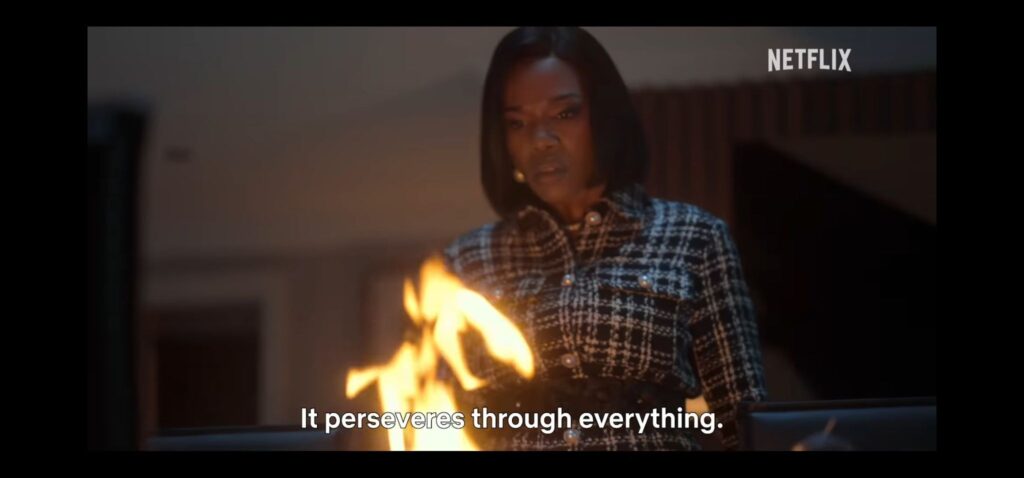
For the better part of The Polygamist (2026), Joyce was the mumu, the silly wife. The one fighting to keep a man who moved in with another woman for over a year. The one who, despite discovering Jonasi’s tumbleweed of lies, still wanted to stay with the philandering philistine. That scene when she was clutching onto his trousers and trying to prevent him from leaving gave me vicarious embarrassment. Like, Miss Ma’am! You’re drowning in a puddle. Stand up and leave this bald homo sapien! However, when she woke up, baby girl tf woke up and became Jonasi’s karma. She ensured Jonasi’s end was fatal, that he died testate, and that her children were taken care of per the will. Her metamorphosis from dinner-party-hosting, socialite, suburban wife to an unemotional grandmaster was applause-worthy. Her villain arc is a reminder that heaven has no rage like love turned to hatred.
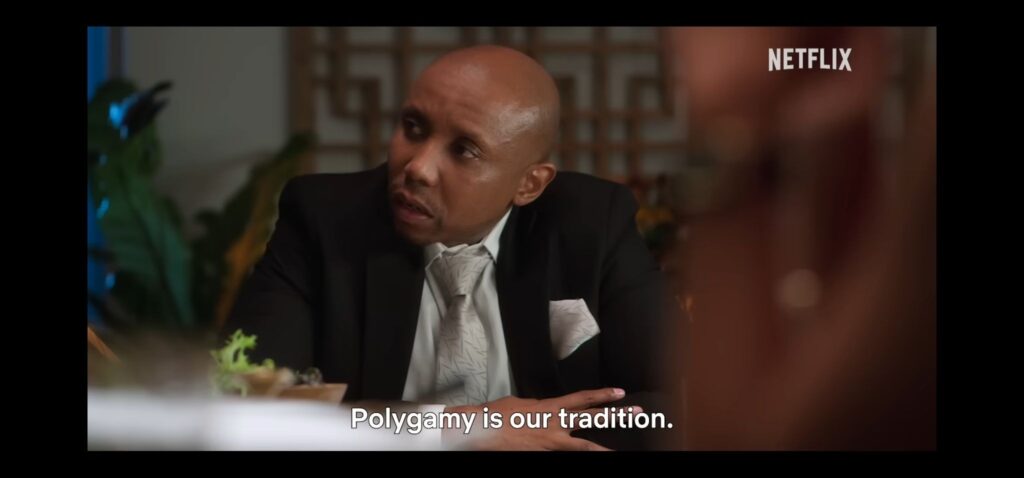
The Polygamist (2026) spotlighted the tragedies of human behavior and had me thinking long after the credits rolled. Like how conscious Matipa and Essie were about keeping their side men hidden, even though Jonasi was openly and obviously unfaithful to them. Or how angry and possessive Jonasi got when he realized Essie and Matipa were getting their guts rearranged by other men. Don’t get me started on him calling Lindani a slut when she was rattling the headboards in the other room while he withered away next door. It was so ironic, like a soot-stained cauldron calling a ceramic kettle black. However, one singular lesson reigns supreme. The consequences of our choices are never insular and isolated. They are far-reaching, leaving a path of destruction that may consume us, just like it did Jonasi.
Hi lovelies. Hope you’ve had a better week than I have. It’s hotter than the devil’s asshole here in England. So I’ve been spending my days drinking my weight in water, hogging fans, and reading articles across different platforms from Substack to The New Yorker. The articles mostly straddle culture, literature, psychology, theology, and technology. I have also been particularly interested in AI and have written about its effects on creativity. Currently, I am obsessed with Juliette Emily’s It’ll Be Okay. Click here to listen to it. As we battle this sulfurous weather and life’s storms, this song reminds me that everything in life—even the negative—is transient and that, at some point, everything will be okay🩷
Don’t forget to comment and share with your friends and network.







This is such an amazing read 👏👏 I wish side chics realize that they’re getting as short an end of a stick as the wife. But Jonasi got what was coming for him. I only feel bad for the kids who have wounds that will reveal themselves in sinister ways. Please do a review of Acrimony next🥺
Such an amazing read 👏👏 I wish side chics realize that they’re getting as short an end of a stick as the wife. But Jonasi got what was coming for him. I only feel bad for the kids who have wounds that will reveal themselves in sinister ways. Please do a review of Acrimony next🥺